Tuesday · August 4
4:00–4:55 PM
Wellness Shortcuts
Zambezi · hands-on breakout
THE KEYNOTE QUESTION
A polished artifact no longer tells us enough. This companion helps you name the human work, audit one task, and redesign one piece so understanding becomes visible.
The current audience release is open now. Live-event polling stays separate, and nothing you enter in the planning tools is sent to us.
BEFORE YOU USE ANY OF THIS
This companion is built for adult educators, not for independent student use. The examples are illustrative, and anything an AI produces needs your review before it reaches a student or family. Whatever you try: follow your school or district's policies on AI, student data, and privacy—including your FERPA and COPPA obligations—and keep student information out of unapproved systems. Your professional judgment governs.
KALAHARI · AUGUST 4–5, 2026
The complete keynote experience, breakout materials, standards demonstration, downloadable tools, and source trail are collected in the unified Resources library.
Tuesday · August 4
4:00–4:55 PM
Zambezi · hands-on breakout
Wednesday · August 5
8:30–9:25 AM
General session · keynote
Wednesday · August 5
10:30–11:25 AM
Nile and Orange · hands-on breakout
WHAT WE PROTECT
The products may change. These are capacities a learner must develop—not five new things to submit.
Internal material thinking can work with.
Deciding what is true, useful, ethical, and worth doing.
Making thinking public through listening, pushback, and revision.
Purposeful friction where skill and durable understanding form.
The learner's ownership of thought, choice, revision, and action.
PARTICIPATE
Optional reflection for the keynote or the ride home. Nothing is submitted, scored, or sent anywhere.
Private by design: entries stay in this browser unless you copy or export them. Work from a de-identified example—no student names, student work, or family information.
AUDIT
Use a real assignment, prompt, discussion, check-in, project, or assessment. Be literal before you redesign anything.
Private by design: entries stay in this browser unless you copy or export them. Work from a de-identified example—no student names, student work, or family information.
REDESIGN
Do not rewrite the entire assignment. Choose one capacity, one component, and the smallest move that makes learning visible.
Private by design: entries stay in this browser unless you copy or export them. Work from a de-identified example—no student names, student work, or family information.
STANDARDS DEMO
A step-by-step walkthrough of the live Unpacking Standards tool: pick a real first-grade Ohio standard, watch its own words come apart, and see every planning resource it hands back — with the teacher's judgment kept in charge at every step.
Find the standard
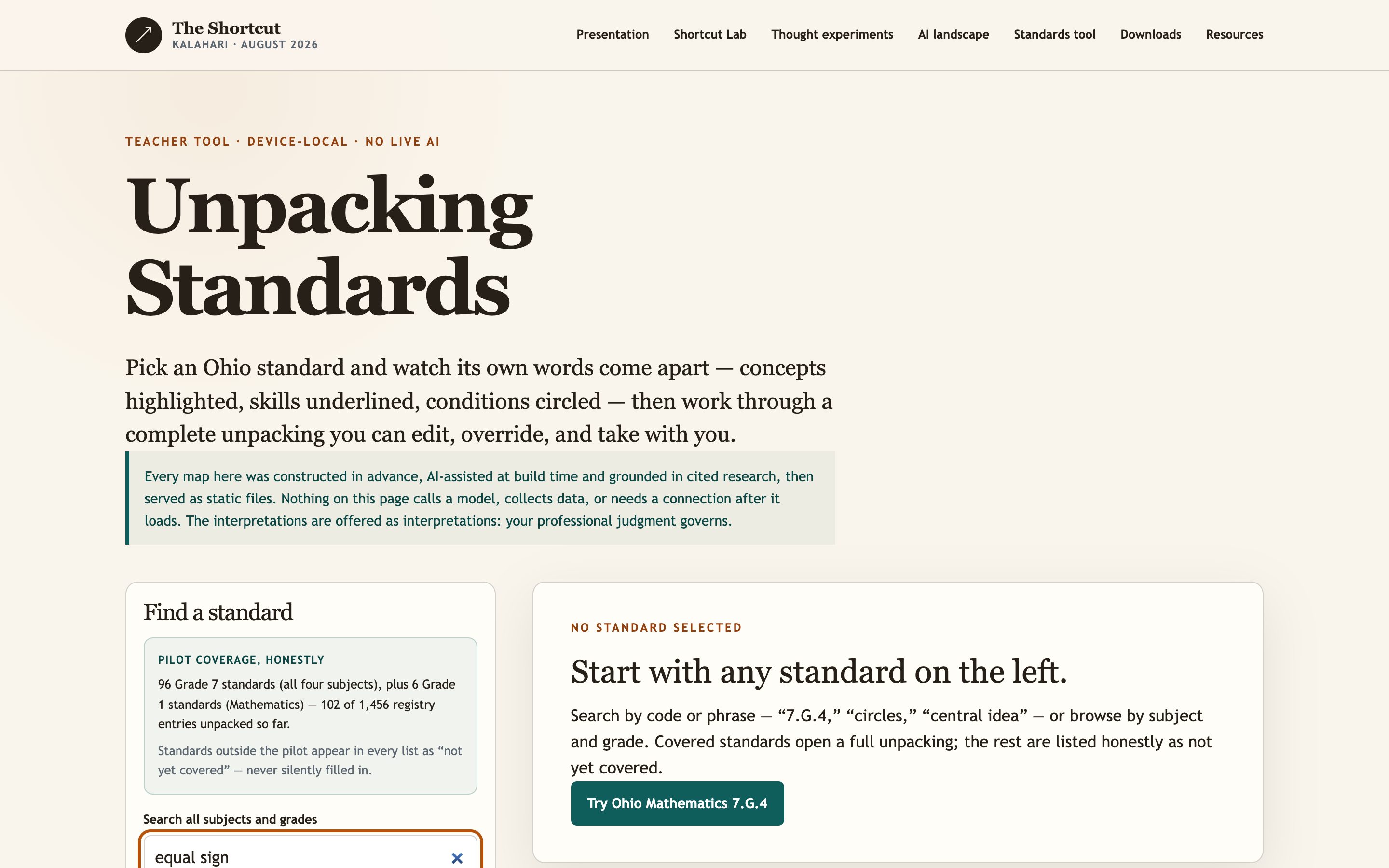
Search by code or plain words — here, Ohio Mathematics 1.OA.7: 'Understand the meaning of the equal sign, and determine if equations involving addition and subtraction are true or false.' Every standard in Ohio's core four is listed, and coverage is stated honestly: unpacked standards say ready, the rest say not yet covered — never silently filled in.
Teacher judgmentThe teacher picks the destination before AI organizes anything. The tool starts from the official text, never a paraphrase.
DECIDE
Color the task part—not the whole assignment. The because clause names the learning, not merely the rule.
Private by design: entries stay in this browser unless you copy or export them. Work from a de-identified example—no student names, student work, or family information.
RETURN LATER
Export your private working copy, revisit the tools, or go deeper into the ideas and evidence behind the keynote.
Download a plain-text copy that opens anywhere and can be pasted into a planning document or LMS.
Run the audit and redesign again with a PLC, department, grade band, intervention team, or counseling team.
Read the source notes behind learning, understanding, achievement, tools, cognitive effort, and human flourishing.
ONE QUESTION TO KEEP
What did this task require the student to do that mattered?